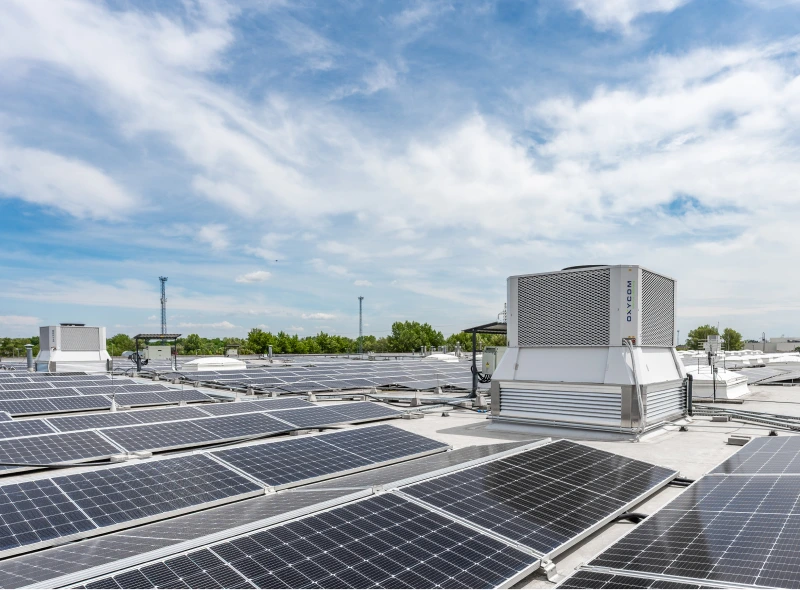
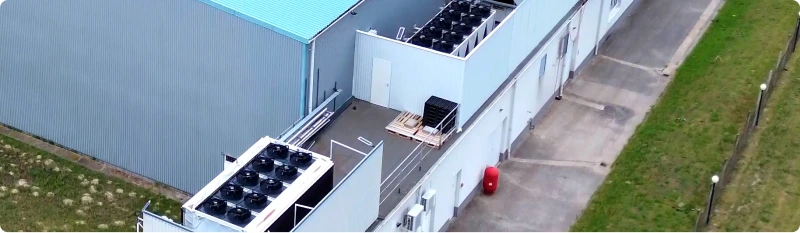
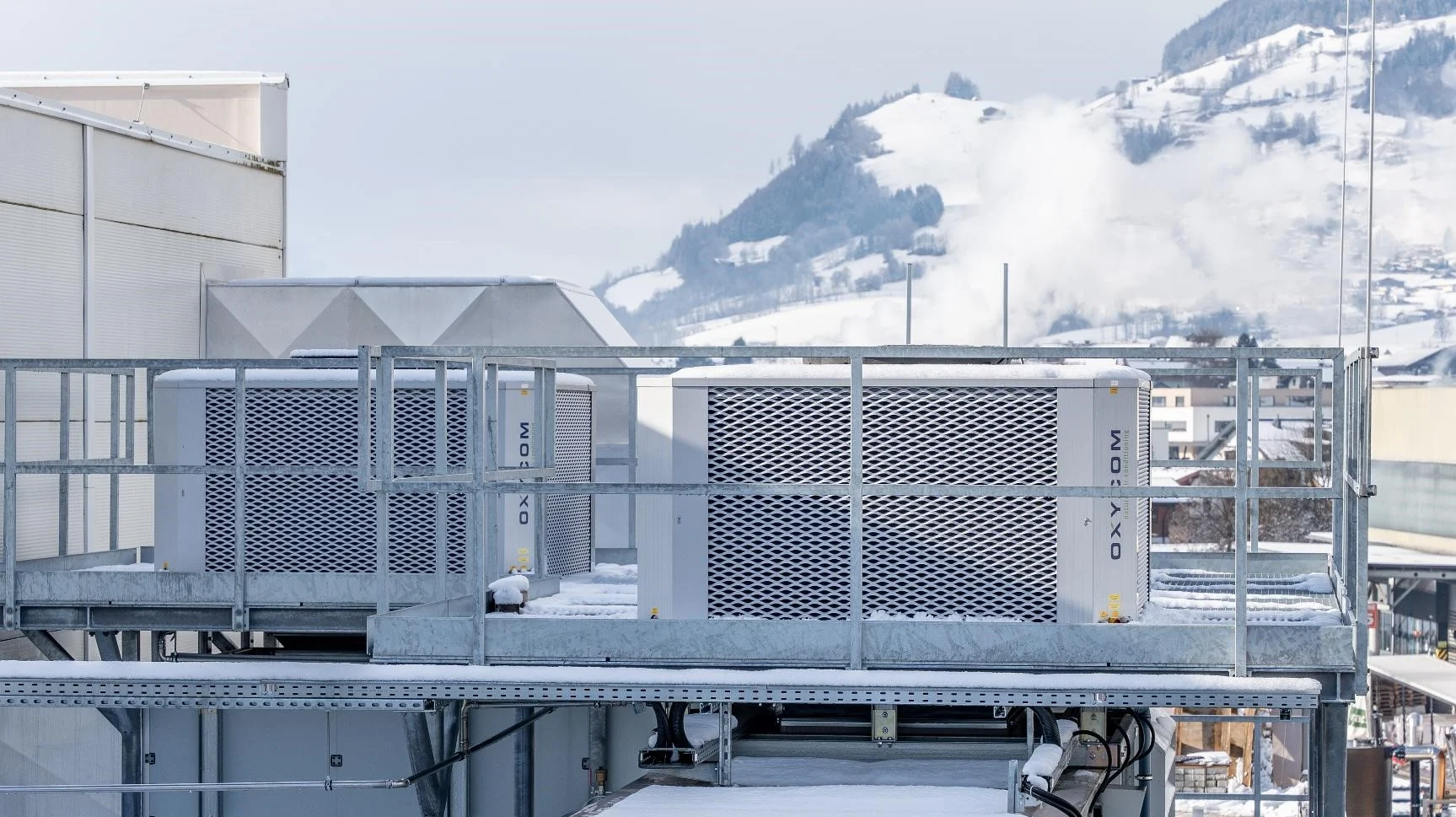
When we modernise not just an existing system but the entire way it operates, a new level of sustainability becomes possible.
60-80%
Ventilation energy savings
90-95%
Cooling energy savings
40-70%
Heating energy savings
100%
Fresh air
6-10 /h
Air changes
The essence of platform transformation
A new system architecture, not just component replacement
For large, open-plan industrial halls, it is worth considering whether a decentralised IntrCooll™-based solution could deliver greater value than further upgrades to a conventional system — fundamentally rethinking the way the hall is conditioned.
Energy-efficient cooling
Intelligent ventilation
Air quality control
Heating and heat recovery
01
Decentralised air handling
Lower air resistance, more efficient air movement and reduced energy consumption.
02
Two-stage adiabatic technology
Natural cooling based on water evaporation, without compressors or F-gases.
03
Four-season operation
Heating, heat recovery, waste heat utilisation, ventilation and air quality control can all be integrated.
04
System-wide value
Energy performance, control, maintenance and investment alternatives brought together in one holistic system solution.
Every decision should be based on the facility's technical characteristics, investment alternatives and expected life-cycle costs.
Would you prefer to upgrade your existing system?
If retaining the existing HVAC system is more advantageous than a platform transformation, targeted improvements can still deliver significant results.
A technology platform transformation is not the right choice for every facility. In certain situations, however, further upgrades to the existing HVAC system can deliver only limited improvements, while its underlying energy and operational burdens remain unchanged.
High energy consumption
Operation requires substantial electrical power, particularly with high airflow rates and continuous operation.
Ageing infrastructure
Maintenance and repairs are becoming more frequent, and the cost of major refurbishment or replacement is now a pressing consideration.
Complex system architecture
Central air handling units, extensive ductwork and associated building services components are complicated and costly to operate.
High peak demand
Electrical peak loads affect both the available power capacity and operating costs.
Operational burden
Maintenance, compliance and long-term operational risks.
Limited improvement potential
The limitations of the existing system prevent significant gains in efficiency.
System sizing limitations
Most systems in operation today were not designed for rapidly warming climatic conditions.
If several of these challenges apply, the question is no longer just how to improve the existing system, but whether it is time to move hall conditioning onto a new technological foundation.
What makes the IntrCooll-based platform different?
Same task. Two different system architectures.
Two-stage adiabatic cooling is energy-efficient in its own right. The real value of platform transformation, however, lies in combining cooling, air handling and control functions within a new system architecture that can also accommodate additional four-season functions.
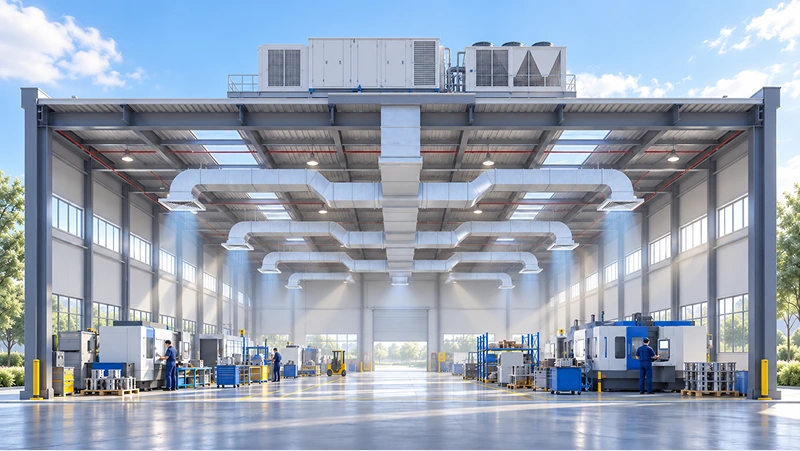
Conventional HVAC
Air handling unit + chiller + refrigerant circuit
1
2
3
1
Centralised air handling
Centralised operation · Complex ductwork · Limited zone control
2
Extensive ductwork
Significant air resistance on supply and extract sides · Higher fan power demand · Increased consumption
3
Compressor-based cooling
High electricity demand · Complex maintenance and operation
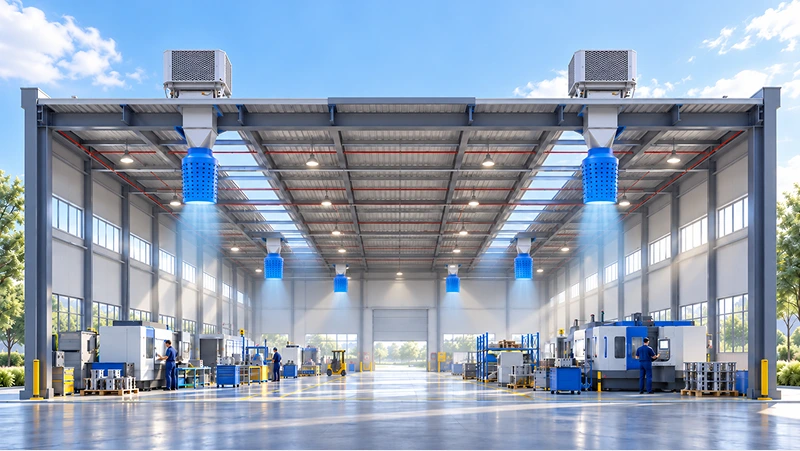
IntrCooll technology
Low-energy, refrigerant-free cooling
1
2
3
1
2
3
1
Decentralised units
Decentralised units · Placement according to demand · Simple system architecture
2
Exceptionally low air resistance
Short, simple air paths · Low air resistance · Minimal energy demand
3
Two-stage adiabatic cooling
Cooling without compressors or refrigerant gases · Very low energy consumption and environmental impact
Eight technical benefits that create system-wide value
Lower peak power demand
Compressor-free cooling
Lower peak electrical load
Greater production capacity
Simpler maintenance
No compressor, leak testing or refrigerant top-ups
Intelligent control adapts the system's operation to the seasons and the hall's current needs. In summer, the focus is on cooling and intensive ventilation; in winter, on providing the necessary air changes while retaining heat.
Summer
Efficient cooling and intensive ventilation
Two-stage adiabatic technology provides hall cooling and fresh-air ventilation in line with the current heat load.
Spring/autumn
Free cooling through ventilation
When the outdoor air is cool enough, the system can cool the hall through fresh-air ventilation alone, without adiabatic cooling.
Winter
Air quality and heat reclaim
Ventilation rates are adjusted to measured air quality, while filtered air recirculation and heat reclaim help reduce heating demand.
Would you like to learn more about the technology?
IntrCooll two-stage adiabatic technology can form the basis of new hall conditioning systems and can also be used to modernise existing air handling units and rooftop units.
Savings do not come from the efficiency of a single piece of equipment. Fans, air resistance, cooling technology and control together determine a system's energy demand.
The following calculation examples illustrate when platform transformation can deliver a meaningful improvement.
01 · Ventilation energy
Ventilation energy demand is a system-level issue.
≈80%
Ventilation electricity savings in the modelled configuration
This comparison examines the ventilation energy demand of a conventional air handling unit and IntrCooll units at a comparable airflow rate of approximately 70,000 m³/h.
The chart shows the fans' annual electricity demand, not the building's total energy consumption. The model assumes 24/7 operation, and the IntrCooll figures are calculated without modulation.
Annual electricity consumption (kWh/year)
Conventional air handling unit
664,132
Modernised air handling unit
≈420,000
IntrCooll – without modulation
131,400
02 · Cooling technology
The choice of technology can transform cooling energy demand.
In the annual model shown, IntrCooll's two-stage adiabatic cooling technology has a substantially lower electricity demand than a conventional chiller, even when the latter is equipped with various precooling and heat utilisation upgrades.
Annual cooling electricity consumption (kWh/year)
Chiller
280,922
Chiller + PreCooll
229,600
Chiller + PreCooll + ReturnCooll
172,200
Chiller + PreCooll + ReturnCooll + EnerCO
149,815
IntrCooll
14,924
These figures compare cooling technologies; they do not automatically include the electricity consumption of all building services functions.
03 · Modernisation alternatives
Which modernisation strategy offers the greatest potential?
3.3 years
Payback period for the modelled technology transformation
~1–2 years
Compared with an alternative investment
Annual savings potential (kWh/year)
Platform transformation
2,673,704
Parallel hall cooling
1,279,346
AHU post-cooling
519,779
The technical presentation quantifies several IntrCooll-based interventions within a specific modernisation concept. For the technology transformation scenario, the modelled annual savings potential is 2.67 million kWh, with an estimated simple payback period of 3.3 years.
The three calculation examples assess different interventions.
The values shown are preliminary, model-based comparisons. Actual results depend on the application environment, calculation assumptions and system configuration.
What could this mean for your hall?
During our free technical consultation, we assess your facility's characteristics, identify potential savings and help determine the most effective modernisation strategy.
Continuing to operate an ageing HVAC system, partially modernising it or replacing it with a conventional solution all involve costs.
The economics of a technology platform transformation should therefore be assessed against realistic investment alternatives rather than in isolation.
What makes up the total business value?
The goal is not simply a short payback period, but an investment decision that delivers greater value over the long term.
opex
+
capex
+
Other risks and economic impacts
Opex
Direct energy savings
Lower electricity demand for cooling and ventilation
Reduced peak power requirement
Opex
Operation and maintenance
Simpler system architecture
Fewer conventional refrigeration components
Potential to eliminate certain maintenance tasks
capex
Avoided capital expenditure
Planned refurbishment or replacement of ageing air handling units, chillers and related infrastructure must also be taken into account.
Risks and other economic impacts
Eliminating certain refrigeration circuits and system components can reduce refrigerant-related, maintenance and system availability risks.
Suitability and technical assessment
When is technology platform transformation the right decision?
An IntrCooll-based platform transformation is not a universal answer to every building services challenge. It can be particularly valuable for large, open-plan industrial halls, but air handling requirements, process needs and economic considerations must all be assessed to determine the right strategy.
Platform transformation
Worth considering if…
01
Large, open-plan industrial hall
Decentralised air supply and the required air change rate can be tailored to the space.
02
Significant cooling or ventilation demand
High airflow rates and long operating hours make system efficiency a key business consideration.
03
Ageing central HVAC system
Maintaining the existing air handling unit, chiller or ductwork is becoming increasingly costly.
04
Major refurbishment or replacement is planned
The planned investment should be compared with the alternative of a new system architecture.
05
Fresh-air supply is a key priority
The building's ventilation and indoor air quality objectives call for comprehensive system design.
06
Four-season functions are needed
Cooling, ventilation, heating and air quality control need to work together.
Alternative strategy
Another approach may be better if…
01
Highly compartmentalised or specialised hall
Existing air distribution requirements are not well suited to a decentralised system.
02
Strict process requirements
Precise temperature, humidity or airborne contaminant control is required, and source extraction remains a priority.
03
The existing system can be upgraded cost-effectively
Targeted fan, filtration, cooling or control retrofits may be sufficient.
04
Technical or architectural constraints
Installation, air supply, equipment placement or operating conditions may prevent the transition.
Based on site assessments and calculations, Oxyma evaluates whether retrofitting the existing system, carrying out a partial modernisation or undertaking a technology platform transformation will deliver the greatest long-term value.
From free consultation to a complete system solution
From the right decision to successful implementation.
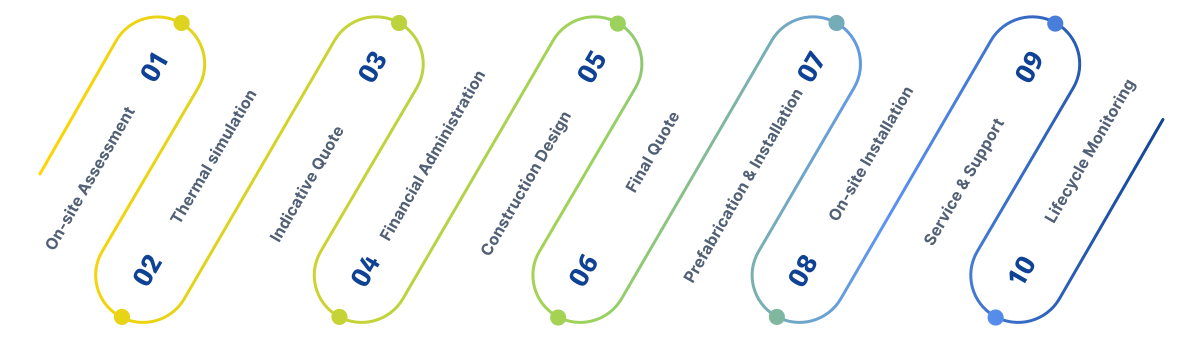
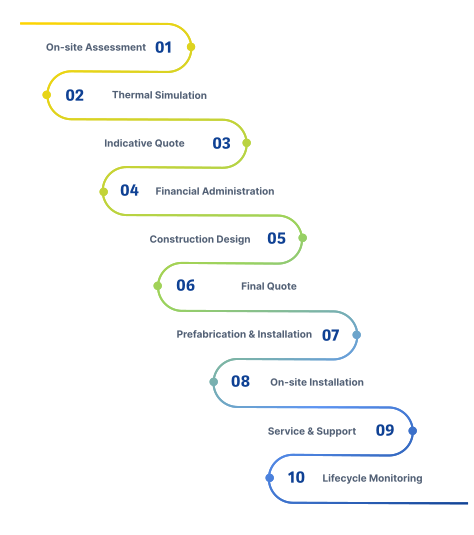
A technology platform transformation does not begin with choosing a piece of equipment:
1. First, we need to understand how the facility operates. 2. Then, we compare the available modernisation strategies from both technical and economic perspectives.
Decision preparation
01
Site assessment and data collection
Assessing the hall, existing systems and operational processes
Collecting technical, consumption and operating data
Outcome
Consolidated hall and operational data
02
Defining objectives and calculations
Aligning requirements, assumptions and alternatives
Calculating heat loads based on weather and process data
Outcome
Calculated heat loads and design parameters
03
Simulation and optimisation
Modelling thermal and energy-performance alternatives
Refining the model using available measured data
Outcome
Expected cooling capacity and energy consumption
04
Preparing the investment decision
Assessing costs, financing and phased implementation options
Summarising technical and commercial findings for management
Outcome
Investment scenarios and management presentation
We do not start with a predetermined product. We look for a solution that can be justified. Suitability and total life-cycle costs guide the decision.
Comprehensive service package, from decision preparation to installation
Weather-based energy and thermal calculations
EKR / TAO / HEM consultancy and energy certification
Administration of environmental tax incentives
Mechanical, automation, electrical and structural engineering design
Full design responsibility
Measurable performance and savings guarantees
Identification of grant opportunities and green financing schemes
Long-term rental options, PPA and ESCO financing
We can also help finance your project.
TAO / EKR / HEM
Green loans / leasing
Grants / ESCO
Alongside selecting the right technical solution, financing feasibility is an important factor in the investment decision. Explore Oxyma's financial assistance services and the available financing options.
1. What does a technology platform transformation mean for an industrial HVAC system?
A technology platform transformation is more than simply replacing equipment. It involves rethinking hall cooling, ventilation and related building services functions at system level. In large, open-plan industrial halls, for example, a conventional system based on centralised air handling and compressor-based cooling can be replaced by a decentralised IntrCooll™-based solution. The goal is lower long-term energy consumption, more efficient operation and reduced life-cycle costs.
2. Is it always worth replacing the existing air handling and cooling system?
No. If the existing HVAC infrastructure is in good technical condition and targeted improvements can achieve the desired results, System Retrofit may be the more cost-effective option. Platform transformation is primarily justified when the basic architecture of the current system limits further efficiency improvements, or when the facility is facing major refurbishment or equipment replacement. Oxyma compares the available alternatives in terms of technical performance and life-cycle costs.
3. Can IntrCooll maintain the required temperature even on the hottest summer days?
The performance of IntrCooll's two-stage adiabatic cooling technology depends on outdoor air temperature and humidity, as well as the hall's heat load and air handling design. Whether the required indoor temperature can be maintained must therefore be assessed individually for each project. Technical surveys and thermal calculations determine the achievable performance for the specific facility.
4. How much water does adiabatic cooling use, and how does it affect operating costs?
Adiabatic cooling removes heat through water evaporation, so it requires a water supply. Water demand depends on outdoor weather conditions, operating hours, cooling load and system design. A financial comparison must therefore consider expected water consumption, water treatment and maintenance costs alongside electricity savings. The precise water balance is determined during system design.
5. Does IntrCooll increase humidity inside the hall?
Two-stage adiabatic cooling combines indirect and direct evaporative cooling processes. The direct stage may increase the moisture content of the supply air, so the expected indoor humidity and process requirements must be assessed during system sizing. In facilities requiring strict humidity control, it is particularly important to verify that the proposed system can meet the specified conditions.
6. How does an IntrCooll-based system operate in winter? Can it also provide heating?
An IntrCooll-based system architecture can be designed for four-season hall conditioning. Alongside summer adiabatic cooling, ventilation, heating and heat recovery functions can be integrated and coordinated through intelligent control. However, the specific winter operating concept depends on the selected system configuration, available heat sources and the building's heating demand.
7. Can general hall ventilation replace local dust extraction or industrial air purification systems?
Not in every case. Fresh-air supply and general ventilation can contribute to suitable indoor air quality, but source extraction may remain essential for controlling dust, fumes and other pollutants generated by industrial processes. Oxyma designs air quality control around actual emissions, applicable limits and the required filtration, monitoring and control functions.
8. Can a platform transformation be carried out without shutting down production completely?
This depends on the existing infrastructure, the location of the selected equipment and the building and mechanical works required. A decentralised design may allow phased installation in some cases, but uninterrupted production cannot be guaranteed without a prior assessment. When planning implementation, Oxyma evaluates technical installation requirements, commissioning stages and the potential need for production downtime.
9. How much does a technology platform transformation cost for an industrial hall?
Investment costs depend on factors such as hall size, cooling and ventilation requirements, the number of IntrCooll units needed, selected additional functions and the extent of modifications to the existing infrastructure. Instead of a universal price per square metre or a fixed investment figure, an individual technical and economic assessment is required. Beyond the initial investment, expected energy, maintenance and total life-cycle costs should also be compared.
10. How are energy savings and the expected return on investment calculated?
The calculation begins by assessing the current HVAC system's consumption data, airflow rates, operating hours, cooling load and technical condition. The expected energy demand and costs of alternative system solutions can then be compared. The payback assessment may account for capital expenditure, electricity and water costs, maintenance expenses and avoidable equipment replacements. An accurate payback period can only be determined through a calculation specific to the facility.
Request a free consultation!
Complete the form below and our team will contact you as soon as possible.
This website uses cookies to enhance your experience. Some are essential for site functionality, while others help us analyze and improve your usage experience. Please review your options and make your choice.
If you are under 16 years old, please ensure that you have received consent from your parent or guardian for any non-essential cookies.
Your privacy is important to us. You can adjust your cookie settings at any time. For more information about how we use data, please read our privacy policy. You may change your preferences at any time by clicking on the settings button below.
Note that if you choose to disable some types of cookies, it may impact your experience of the site and the services we are able to offer.
Essential cookies and services enable basic functions and are necessary for the proper functioning of the website. These cookies and services do not require user permission according to GDPR.
This category includes all cookies, domains, and services that do not fall into the other specified categories or have not been explicitly categorized.